A vast trove of declassified files on Jeffrey Epstein’s sexual, political, and intelligence escapades released by the US Department of Justice has once again thrust disgraced former Prince Andrew Mountbatten-Windsor into the spotlight. With British police reportedly reviewing Andrew’s past sexual activities and links to Epstein, questions are growing about whether Britain’s spy agencies were aware of Andrew’s alleged escapades with minors.
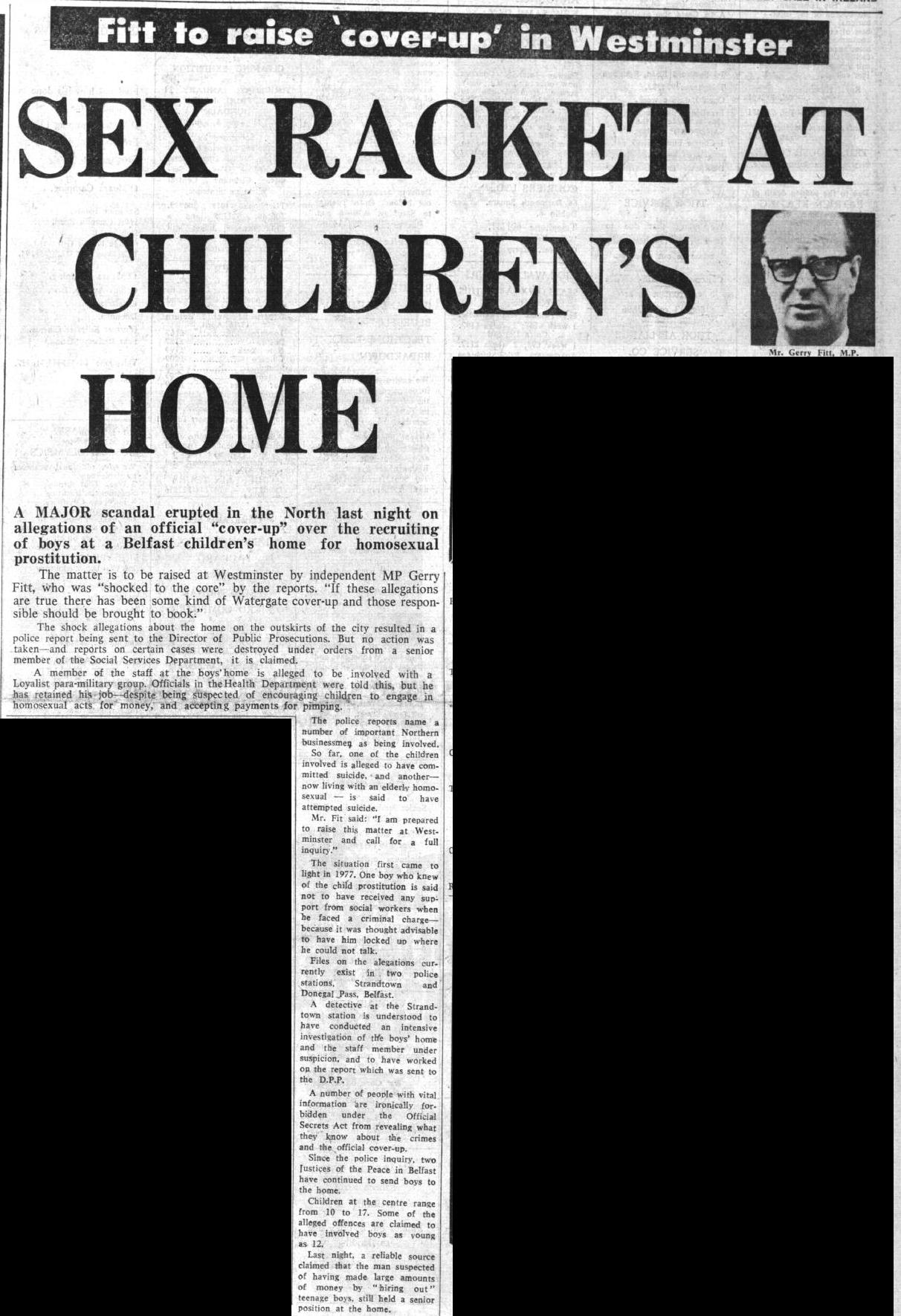
If the darkest rumors turn out to be true, it will not be the first time a British royal had been embroiled in a child rape conspiracy with spy agency involvement. Back in 1980, a scandal erupted when the Kincora Boys’ Home in occupied Ireland was exposed as a secret brothel run by powerful pedophiles. Chief among the alleged perpetrators was Lord Mountbatten — Andrew’s great-uncle.
From the very beginning, hints began to appear that MI5/MI6 knew of the child abuse taking place Kincora, and could have even been running the group home as part of a dastardly intelligence plot. With Britain’s domestic and foreign spies engaged in a savage dirty war in Ireland, and both services running operatives in Republican and Unionist paramilitaries, Kincora would have provided an ideal means of recruiting and compromising potential assets. Official investigations have strongly insinuated British intelligence chiefs had a close bond with many individuals who ran the Boys’ Home.
In May 2025, veteran BBC journalist Chris Moore published a forensic account of the case titled Kincora: Britain’s Shame. Featuring four and a half decades of firsthand research by the author, its groundbreaking contents have been met with general silence by British mainstream media.
In the book, Moore argues persuasively that the Boys’ Home was just one component of a more extensive child abuse network extending across British-occupied Ireland and beyond — in which London’s spying apparatus was not only aware, but likely complicit.
In 2023, Moore met personally with Kincora victim Arthur Smyth in Australia. Smyth’s stay at the Home was brief, but the horrors he endured there left him scarred forever.
“Having interviewed a number of Kincora survivors, I found Arthur’s story familiar. Sent to the Boys’ Home by a Belfast divorce court judge aged 11, he was continually preyed upon by the pedophiles who ran it, and intimidated into silence,” Moore told The Grayzone. “Arthur was also brutally abused repeatedly by a man he knew only as ‘Dickie’, who raped him while bending him over a desk.”
In August 1979, two years after Smyth escaped Kincora, he learned the true identity of ‘Dickie’ was none other than Louis Francis Albert Victor Nicholas Mountbatten, a member of the royal family and Queen Elizabeth II’s cousin. Mountbatten had just been murdered in an apparent IRA bombing attack on his fishing boat off the coast of Ireland. Though the British government appears to remain committed to concealing his crimes from the public, Mountbatten’s pedophilia was common knowledge among both British and US intelligence for decades.
As early as World War II, the FBI had identified Mountbatten as “a homosexual with a perversion for young boys.” A Bureau file detailing this was later identified by historian Andrew Lownie. After requesting other files the Bureau maintained on the royal, Lownie was informed by US authorities they had been destroyed.
Lownie says he was told by an FBI official that the files were only disposed of “after [he] asked for them” — indicating they were “clearly” shredded at the request of the British government.
Within months of Kincora’s opening in 1958, boys at the facility began coming forward to inform the adults around them that they were being routinely sexually abused. The Boys’ Home was repeatedly visited by police throughout the decades that followed in response to reports of rape and other mistreatment. Despite repeated investigations, time and time again, complaints were ultimately dismissed by the police.
Reports of sexual abuse spiked dramatically in 1971, when a prominent loyalist named William McGrath became the group home’s housefather, and was placed directly in charge of the boys’ day-to-to lives. Moore documented numerous harrowing accounts in which victims described being sadistically raped by McGrath to the point of internal bleeding, with the boys’ silence ensured by threats of violence.
Moore attributes police inaction to the “skillful manipulation” of Kincora’s director, Joe Mains, who successfully convinced officers that accusers were simply lying as revenge for perceived slights by the staff.
As an extremely well-networked figure in British-occupied Ireland, with deep links to prominent Unionist politicians and Protestant paramilitary groups, McGrath enjoyed virtual impunity. He also headed Tara, an armed Masonic loyalist faction covertly run by the British Army, which effectively functioned as an intelligence operation.
In conversations with colleagues, McGrath was known to boast about his work with British intelligence, and the regular trips to London which it entailed. A police source confirmed to Moore that MI6 had an interest in McGrath since the late 1950s, and that “everything McGrath did from this point on was known” to British intelligence. Small wonder campaigners firmly believe Kincora was exploited to compromise and control Unionists, who committed pedophilic offenses at the Home.
The horrifying abuse at Kincora finally surfaced in January 1980 when the Irish Times published an explosive report that triggered a police investigation, which was led by a veteran detective named George Caskey. According to Moore, it took Caskey just three days to decide that Kincora’s leadership were likely guilty.
Within weeks, Caskey’s team had identified dozens of victims of McGrath and others at Kincora, who each gave detailed statements about the abuse they suffered there. Based on their testimony, Mains, McGrath and fellow high-ranking staffer Raymond Semple were suspended from the group home, and arrested a month later. Curiously, Mains and Semple readily admitted their offenses to police, but McGrath aggressively protested his innocence. Resisting interrogation with such skill that investigating officers believed he had rehearsed for their questioning in advance, he made a number of bizarre, cryptic comments.
For one, McGrath declared he was the victim of political intrigue and the accusations against him were bogusly cooked up by the pro-British Ulster Volunteer Force paramilitary faction, among other people “out to destroy me.” He refused to elaborate on who they were, or why he believed he was being maliciously targeted in this manner. McGrath furthermore promised “other stories” and a “rebuttal to these allegations” would “come out in court,” but again declined to expand any further.
In December 1981, Mains, McGrath, Semple and three other individuals found to have abused young boys at two other state-run group homes in occupied Ireland finally stood trial. McGrath was the only defendant to plead not guilty. Present in court at the time, Moore recalls widespread anticipation McGrath’s testimony would “open a Pandora’s Box, laying bare the truth about Kincora and exposing an uncomfortable – some might say unholy – alliance between the British government and unionism, and perhaps even details of a secret MI5 operation.”
However, at the last minute, McGrath’s lawyer made a shock announcement – his client had changed his plea to guilty. McGrath’s volte face elicited a ripple of exasperated sighs across the courtroom, where over 30 Kincora victims had gathered, preparing to testify. Though all six men were convicted of sexual abuse of boys across three Belfast children’s homes, their relatively light sentences drew outrage. In the end, Mains was jailed for six years, while Semple received five years and McGrath, just four.
For Moore, McGrath’s change of heart raises obvious suspicions that someone persuaded him to keep his mouth shut about “what had been said to him and by whom.” The police investigation established the six men knew each other and shared information about abused children in state-run boys’ homes, but did not explore the possibility they were part of a wider pedophile ring. The most significant official probe into Kincora since, the Northern Ireland Historical Institutional Abuse Inquiry (HIA), initially raised hopes such information might emerge when it was launched in 2013.
That probe, which centered around allegations by British intelligence whistleblowers Colin Wallace and Fred Holroyd that the UK security state was complicit in systematic child rape at Kincora, appeared to leave MI5 extremely uneasy about the potential for British spies’ darkest secrets coming to light in occupied Ireland.
The HIA, however, appears to have been set up to fail. With no ability to compel MI5 or MI6 to produce records, the commission was forced to accept only whatever heavily redacted files the agencies voluntarily provided.
The decision to limit the scope of the HIA’s oversight came despite appeals by prominent figures including victims of sex abuse at Kincora, parliament’s home affairs committee, and former military officials, who claimed British intelligence was complicit in abuses at Kincora, and demanded the Inquiry be granted the ability to subpoena sensitive documents and witnesses.
As anonymous security and intelligence operatives spoke via videolink in the HIA hearings, Inquiry chair Judge Anthony Hart appeared to take their testimony at face value.
The Inquiry’s handling is all the more shocking given the contents of a June 1982 document provided by MI5 to the HIA showing how the agency’s higherups planned to counteract the inquiry itself.
Anxious to distance themselves from the horrors of Kincora, the British spy agency discussed creating “false files” to counteract “lines of enquiry which it was anticipated” that Caskey might pursue. In other words, MI5 was actively seeking to deceive police investigators through forgery.
But the HIA later declared it was “satisfied” that “the suggestion was not pursued,” concluding that the “false files” were not produced for the purposes of misdirecting the inquiry.
In 2020, it was revealed that extensive police records on investigations into Kincora from 1980 to 1983 had conveniently been destroyed roughly around the time the Inquiry was established.
The files which survived show the HIA received a number of tips suggesting MI5/6 were indeed entangled in pedophilic abuse at Kincora, only to consistently understate their significance.
For example, MI5 told HIA it had no records of William McGrath working for the agency. Conversely, documents produced by the intelligence service indicate how in April 1972, McGrath, who was “commanding officer of the Tara Brigade,” had not only been plausibly “accused of assaulting small boys,” but “could not account for any cash that had been handed to him over a period of a year.”
The HIA accepted MI5’s risible explanation that this information was not passed on to local police because it was unclear McGrath’s attacks on the boys were pedophilic in nature, rather than simply physical. “We ought not to assume that ‘assault’ would have been interpreted at the time by…[MI5] as being of a sexual type,” an internal document presented to the Inquiry declared.
Responding to a separate MI5 document from November 1973 noting McGrath was implicated in “assaulting small boys,” the HIA noted British intelligence was legally obligated to report such an “arrestable offence” to the police, and that by not doing so, it could be argued “the MI5 officers who had this information were in breach of that duty.” But the Inquiry concluded that “to take that view would be unjustified for several reasons,” primarily that “an unidentified member of Tara” was the source of this “unsubstantiated allegation.”
Similar mental gymnastics were employed to downplay the contents of an October 1989 MI6 file detailing “various allegations surrounding the Kincora Boys’ Home,” which revealed the spy agency “certainly ran at least one agent who was aware of sexual malpractice at the home and who may have mentioned this” to his handler. Judge Hart stultifyingly concluded, “it is quite possible the [MI6] officer misinterpreted what was discussed at the meeting.”
The HIA also insisted MI5 was unaware McGrath worked at Kincora until 1977. But that claim was effectively contradicted by the Inquiry itself, which unveiled MI5 documents from January 1976 clearly stating, “McGrath was reported in March 1975 to be warden of Kincora Boys’ Hostel.” A police memo from November 1973 dispatched to MI5’s director similarly noted McGrath was a “social worker” at Kincora.
As part of its probe, the HIA ordered “searches of documents and records” held by MI5, MI6, GCHQ, and the Metropolitan Police on allegations of child sex abuse by public figures and servants. In response, MI5 released files listing 10 powerful individuals, including diplomats, government ministers, and lawmakers, who Britain’s domestic spying agency had evidence to suggest may have been involved in pedophilic abuse.
Chief among them was veteran spy and dark arts specialist Maurice Oldfield, who oversaw MI6 operations in occupied Ireland throughout the 1970s, first as its deputy then chief. Shortly before his April 1981 death, Oldfield was outed as gay, which precluded him from serving with the agency under contemporary recruitment rules. Resultantly, “MI5 conducted a lengthy investigation to determine whether” Oldfield’s sexual proclivities “posed a risk to national security by making him vulnerable to blackmail or other pressure.”
Over the course of “many interviews,” he “provided information about homosexual encounters with male domestic staff, referred to as ‘houseboys’, whilst serving in the Middle East in the 1940s and hotel stewards in Asia in the 1950s.” Media reporting prior to Oldfield’s death suggested he was “a compulsive” user of “rent boys and young down-and-outs,” which was well-known to his security detail. However, the HIA repeatedly exonerated Oldfield of any wrongdoing, despite receiving bombshell evidence implicating him in the horrendous pedophilic acts perpetrated at Kincora.
Unbelievably, its report concluded “there is insufficient information in the records to deduce whether the term ‘houseboys’” was “used simply to describe domestic staff or to denote youth, leaving ambiguity over the ages of the other parties.” This is despite an anonymous MI6 officer telling the Inquiry the agency possessed four separate “ring binders” documenting Oldfield’s “relationship” with Kincora, his “friendship” with its chief Joe Mains, and potential personal connection to “alleged crimes at the boys’ home.”
Heavily redacted files published by the HIA also indicate MI5 was “aware of allegations” that occupied Ireland’s police knew Oldfield was intimately embroiled in the scandal. An internal agency telegram noted well-grounded suspicions the MI6 chief “was involved in the Kincora boys home affair in the course of occasional visits to Northern Ireland (associated with his job) between 1974 and 1979.” Still, the Inquiry dismissed this as proof of MI5/6 involvement in the child abuse conspiracy, on the grounds these excerpts referred purely to “allegations.”
The Kincora coverup continues today. In April 2021, the BBC announced “a new season of landmark documentaries… set to shine a new light on remarkable stories from Northern Ireland’s recent history.” Among the scheduled films was Lost Boys, which told the hideous tale of how numerous children inexplicably vanished in Belfast during the Troubles. It concluded the cases were all linked to pedophilic abuses at Kincora. Interviewees included several former police officers, who believed their inquiries into the disappearances had been systematically sabotaged by British intelligence.
On the eve of transmission, Lost Boys was pulled from broadcast. BBC managers were reportedly “shocked by its content, particularly evidence of MI5’s involvement in covering up the Kincora saga.” Moore, who consulted on the film, told The Grayzone there are strong insinuations British intelligence took a keen interest in the documentary’s producers, AlleyCats. “The home of one staffer involved in editing Lost Boys was burgled,” he says. “Another Alleycats member suspected a break-in, but could not be entirely certain.”
Having investigated Kincora since it first came to public attention, Moore concludes “MI5 and its cohorts in the police believe they can do what they want with little or no regard for the truth, the law or democracy,” noting British intelligence “somehow persuaded the government to bury Kincora files until 2065 and 2085.” The veteran muckraker also recently learned his private communications with journalists investigating other cases of criminal activity by MI5/6-sponsored loyalist paramilitaries – including murder – have been heavily surveilled.
“The British state has illegally spied on people trying to expose the truth in Northern Ireland for many years, in what they call a ‘defensive operation’. Senior local police chiefs have admitted surveillance tactics were deployed against 320 journalists and 500 lawyers over a decade, including me,” Moore concluded. “My telephone was monitored due to probing government-funded loyalist killers. Like many police officers who’ve looked into these matters, I’m all too aware of how authorities frustrate criminal investigations.”
The National Endowment for Democracy's president, Damon Wilson, bragged to a House committee of his…
A shadowy think tank run by British PM Keir Starmer’s top strategist has been exposed…
The world’s second-largest tech company just acquired a military-linked Israeli startup that uses “facial skin…